ROCD and Social Media: Why Scrolling Makes You Feel More Uncertain
ROCD and Social Media: Why Scrolling Makes You Feel More Uncertain
As a Relationship OCD specialist, I’ve seen countless times how social media makes people’s ROCD worse. After scrolling, they’re left feeling more uncertain and more anxious.
If you don’t see what social media is doing to your mind, you’ll keep walking away from it assuming that something is wrong with your relationship. Here’s how to break the cycle.
Problem 1: When Scrolling Triggers You
Until you’ve recovered from ROCD, you’re more sensitive to triggers - and social media has a ton of content that can trigger your anxiety. And while we don’t want to avoid triggers forever, it’s important in the beginning stages of recovery to give your nervous system a break.
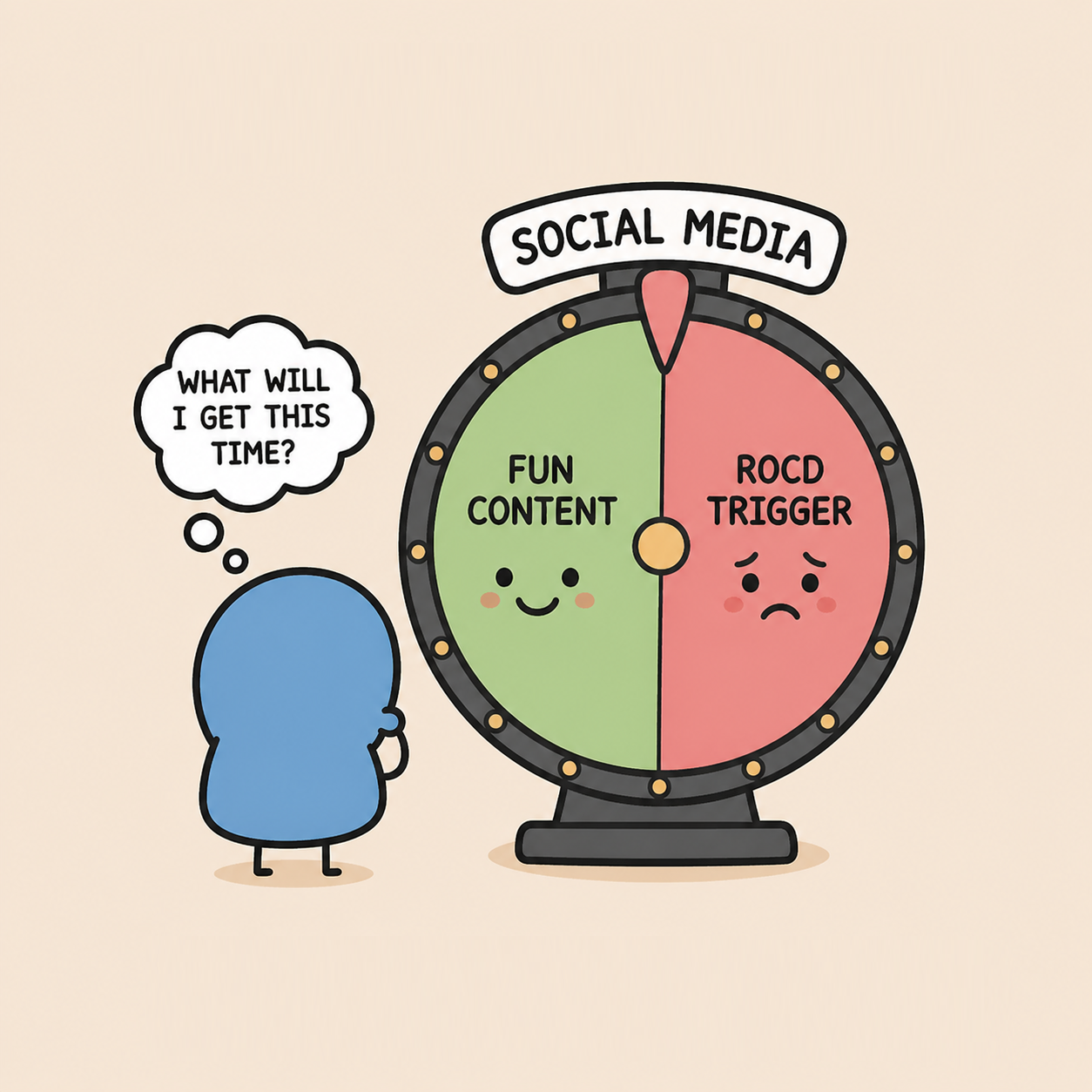
Each time you use social media, you’re spinning a roulette wheel. You want enjoyable content. The algorithm, on the other hand, wants to keep you engaged. It doesn’t care if you’re happy or anxious - it just wants your attention. It will throw whatever content your way that it thinks will grab you. And relationship content is prime material for capturing people’s attention, because relationships are what matter most to us.
It’s for this reason that I recommend at the beginning of recovery that people do a digital detox from social media until they’re more secure in their recovery. Why make the work of recovery harder for yourself? Once you recover, then you can go back to using social media effectively.
Problem 2: When Scrolling Becomes Compulsive
This is the bigger problem: not just being triggered by content that surprised you, but compulsively scrolling through relationship content, looking for answers (aka, certainty) as to what you should do.
This behavior is a compulsion, and compulsions make ROCD worse.
Let’s be even more specific: compulsions create confusion.
The more you compulsively scroll through relationship content, the more confused you’ll be. And being in a state of confusion makes it even harder to recover from Relationship OCD.
Signs Your Scrolling Is a Compulsion
Here are some signs that you’re scrolling compulsively:
Scrolling makes you anxious and yet you keep going.
You tell yourself “Just a little more, then I’ll stop.”
You feel like you have to keep scrolling.
There’s a sense of urgency while you scroll.
It feels like you’re about to figure something out.
It feels like if you stop scrolling, you might miss something important that would give you the answer.
And most important, you don’t feel like your normal, grounded self anymore. (Compulsions make us feel less like ourselves.)
What you’re seeing online isn’t helping you decide. It’s not a solution to your problem. Instead, it’s just throwing more gas on the fire of relationship anxiety.
The more you use social media to “figure out” your relationship, the harder it becomes to trust anything you feel. You start looking for answers outside of yourself, rather than listening to your own heart.
Conclusion
The more relationship content you consume, the less stable your own relationship will feel. Social media trains you to compare your three-dimensional relationship to two-dimension images. It’s not fair to do to yourself or your relationship.
Also, at a basic biological level, scrolling before bed worsens your quality of sleep. Worse sleep leads to more anxiety and less clarity, which keeps the wheel of ROCD spinning.
Even though social media doesn’t cause ROCD, it makes it ten times harder to recover - and recovery is what you need to be focused on.
Recovery from Relationship OCD is 100% possible. If you follow the right approach, it is very likely that you will overcome relationship anxiety.
Meet Cameron
I specialize in treating Relationship OCD (ROCD) and relationship anxiety, helping people break out of obsessive doubt and stop trying to “figure out” their relationship.
If you’re constantly questioning your feelings, your partner, or whether you’re in the right relationship, you already know how urgent and convincing it can feel. I’ve experienced that loop myself—and I know how easy it is to mistake anxiety for clarity.
My work focuses on helping you step out of that cycle and build more clarity and confidence in their choice of partner.
If you’re ready to stop analyzing and start feeling more stable, you can reach out for a free consultation to see if we’re a good fit.
Or, if you prefer to start on your own, my on-demand course for overcoming ROCD includes over 3 hours of audio and practical tools to help you work through ROCD and relationship anxiety.
I’m a Licensed Marriage and Family Therapist offering online sessions and in-person therapy in Oakland, California